I’m a strange person, I admit it. I only drink orange juice filtered — I can’t stand the pulp. My wife teases me about it every time, but all I want is the juice. A sieve, five minutes, done. It was on a Sunday morning, sieve in hand, that the idea for this article came to me: in the cellar we do practically the same thing when we filter wine, just on a much larger scale and with much more care.
Why filter wine
When fermentation is over, the wine is not yet clear: it is cloudy, full of particles in suspension that come from the grapes and from the micro-organisms that transformed them. Over the winter the larger particles settle on their own at the bottom of the tank, and I remove them with a simple racking — nothing complicated. The problem is the smaller fragments, the ones that keep “swimming” in the wine: for those you need proper filtration.
The two methods I use most are sheet filtration and cross-flow filtration.
Sheet filtration
Here the wine passes straight through the filter medium, usually cellulose sheets.
- you need good-quality cellulose — poor sheets pass unpleasant smells and flavours on to the wine
- compared with cross-flow filtration, it removes fewer polysaccharides and other important macromolecules
- it is easy to use, even with small volumes
The downside: it tends to make the wine a little lighter, and with large volumes it leaves a lot of spent sheets to dispose of.
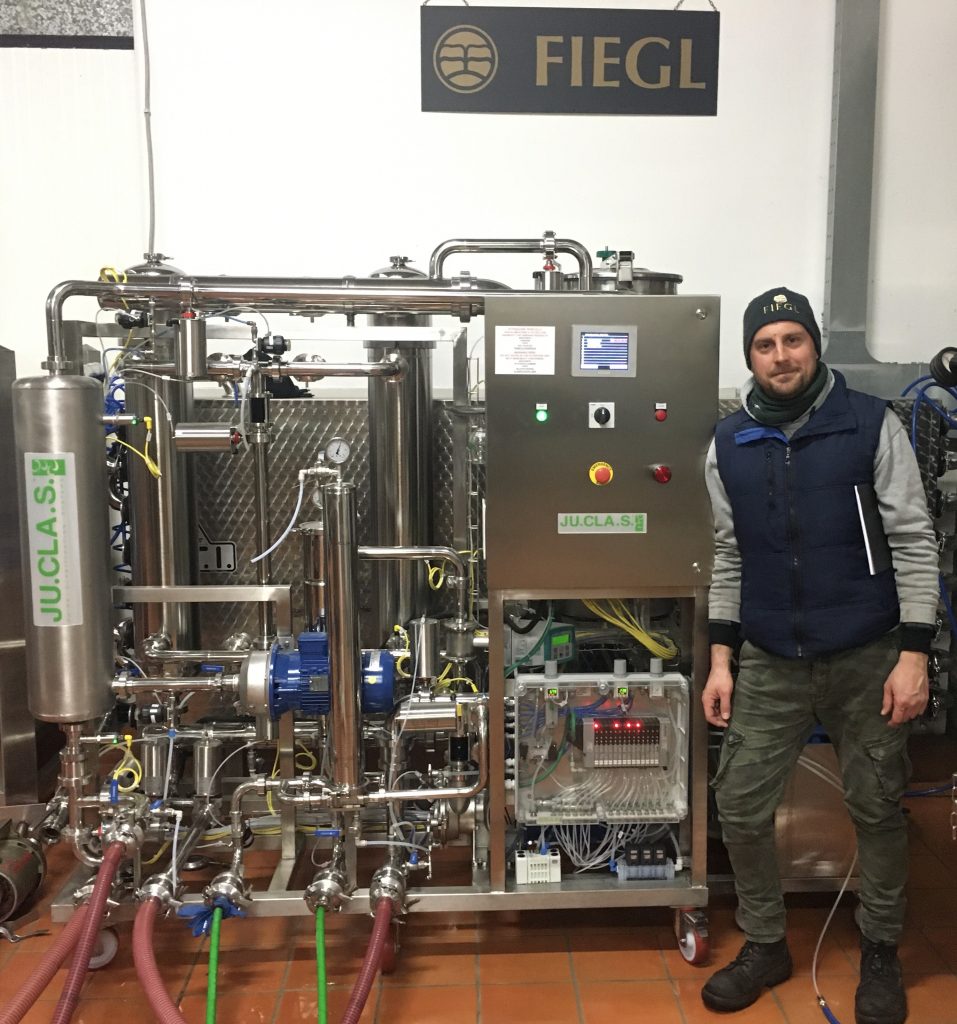
Cross-flow filtration
Here the wine flows parallel to the filter surface rather than against it.
- the filter is a hollow membrane made of polymers that are inert to wine; it is cleaned by back-flushing with hot water and lasts a long time
- I use it when finer microfiltration is needed
- it causes a small loss of tannins and anthocyanins in reds and of polysaccharides in whites — but we are talking about less than 5%
The big advantage is that cross-flow filtration only holds back what is genuinely in suspension, without touching the colloids: the wine’s aromas and flavours remain intact.
How we choose in the cellar
I don’t use the same method for every wine. The choice depends on what I want to achieve: a structured red needs to keep as many tannins as possible, while a fresher white can handle finer filtration without losing its character. It’s the same principle I apply at every stage of winemaking — there’s no single recipe, only the wine in front of you at that moment.
Luckily, I do most of the work in the cellar: anyone opening a bottle of Fiegl doesn’t need a sieve — just the wish for a good glass of wine.
PS: do you know the difference between selected and indigenous yeasts? I wrote about it in this article, trying to keep it simple.